Pronounced: eh-peez-ee-ah-toe-mee, what is this crazy word in the first place? What is episiotomy and how does if affect your body during your birth and recovery afterwards?

It’s something your doctor or midwife likely will never mention during your pregnancy or birth. But if you have a complication or extenuating circumstances, then it’s more likely. But do you even need to worry about it if your doctor never brings it up? I’ll let you decide.
What Is Episiotomy?
It’s a Funny Word for Something Not So Funny
Episiotomy is a big word for a cut your doctor puts between your vagina and rectum through your perineal tissue. Ouch!
So while you’re in the middle of pushing (or breathing) out your baby, trying to focus, your doctor would numb you with a local anesthetic (basically shots in your tenders), then take surgical scissors and increase your vaginal opening by a few inches. It looks like this:
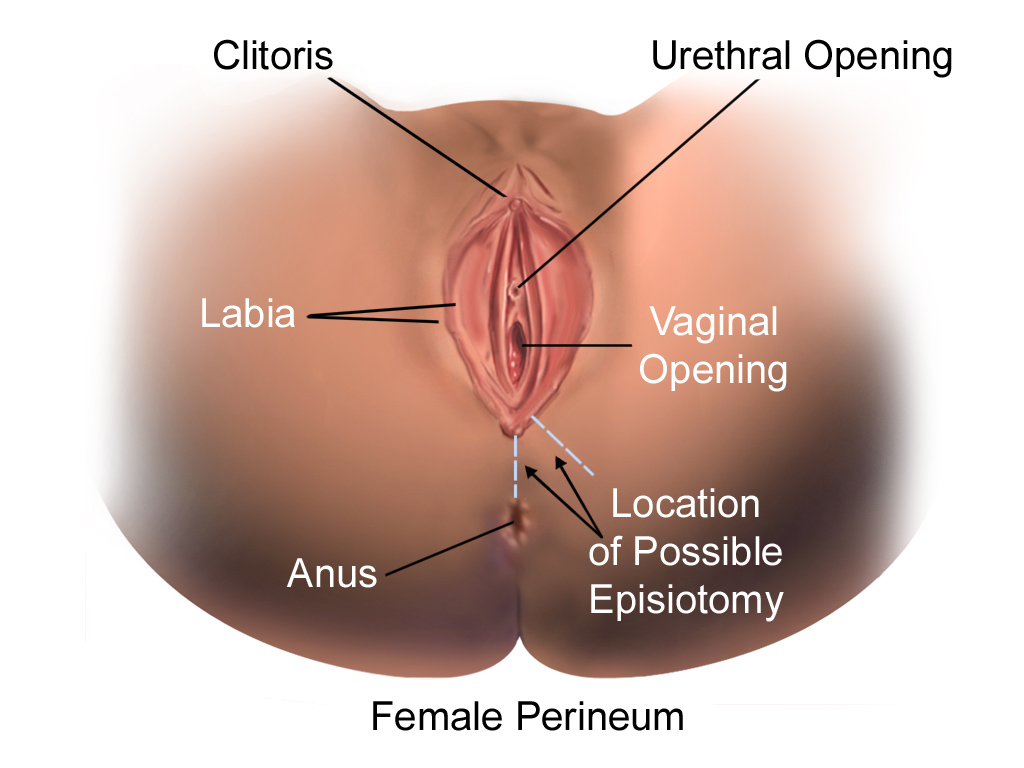
Image courtesy of Wikipedia
Episiotomies were very routine procedures for many years in our mother’s and grandmother’s generations (much like epidurals, ironically). Doctors and surgeons believed that it greatly assisted the delivery of newborns because the opening for them to come through was wider, thus easier and quicker for a delivery.
Wouldn’t we all love it if our vagina was so much bigger during birth? Say our cervix dilated to 20 cm instead of 10, and our vagina could stretch twice as wide, our hips literally separating easily and then springing back post-partum. Wouldn’t that be AWESOME?! The doctor, heck even you and me, could just reach in and slowly pull that baby out without so much effort, like pulling a melon out of a wet bag.
Of course, this doesn’t happen, and we’re built much differently. But the thought of an episiotomy does sound appealing, I’ll admit; and I’ve even considered asking for one myself. I’ll tell you why a little later.
Benefits and Risks of Episiotomy
Originally, it was thought that the benefits of episiotomy were greater than just taking the chance of naturally tearing. Think about it: when you get a scrape on your arm, which would heal faster and cleaner? One caused from a paper cut or one caused from you landing on a rock? Usually the paper cut, of course.
That is the logic behind an episiotomy; a strait incision would clearly heal better and have less consequences right? Think again. I’ll back my point up in a moment.
There ARE cases where an episiotomy is warranted and the risks are less consequential than not having one at all.
| Good | Bad |
| if your baby is larger than normal and assistance may be needed | An Obstetrics & Gynecology 2004 study showed a number of things: |
| if baby needs to arrive quickly due to slowed heart rate or your placenta tears away too soon | – no decrease in urinary or anal incontinence compared to tearing |
| – decreased pelvic floor muscles ability to fully strengthen and heal | |
| – increase in sexual disfunction | |
| – greater pain during intercourse versus from a tear | |
| – greater perineal pain post partum than from a tear |
It seems that simply because a man-made laceration is not normal, that fact alone maybe the reason why the post-healing process is worsened. The perineum is a VERY flexible and sturdy tissue. It is built to take a beating during childbirth. I believe that this very fact is the reason why even tearing is more beneficial–because it’s likely to happen and normal if it does. Why else would you be able to heal better and have better sexual experience afterwards than if you’d elected for an episiotomy? (You can help reinforce it’s abilities through perineal massage.)
But I Don’t Want to Tear Either
I know, it happens. I’ve lived through two bad tears and they’re not fun either. I can’t imagine what someone who needed an episiotomy may feel afterwards then.
I know this is an abdomen, but I really didn’t want to show you a crotch after the fact. But you get the idea….
Many, many women tear during their vaginal birth, and most require stitches afterwards to help repair the damage. The causes for increased chances of tearing are:
- increased maternal age
- posterior presentation of baby
- previous episiotomy
- if this is your first vaginal birth
- if you’ve had a previous 3rd or 4th degree tear
- (this just means that your tear goes through to your anal sphincter or even through your rectum)
- your baby is big (over nine pounds)
In my case, three of those have been applicable to me over the course of my births.
Both of my boys were so eager to greet the world that they came out face up (posterior). And I tore BAD. I had third degree tears each time and my doctors had to stitch me up through my anal opening. Not a fun experience to look down and see a bloody sewing hook in the doctors hand.
Healing from that was NEVER fun–burning, pain, irritation. I lived off of stool softener for two months strait!
Then afterwards, it took months for my husband and I to get back to normal in our sexual routine. Because of my scar tissue, intercourse was PAINFUL and it made me not want to do it ever again. I would only allow certain positions that would decrease the chance of pain for along time until it went away.
Thus I have thought many times about choosing an episiotomy for our third baby, because chances are I’m going to tear every single time I give birth. BUT….
I’m NOT going to. Because now I KNOW that my risks are greater and my healing will be WORSE if I choose to have one. I’m going to do all that I can to help prevent tearing, but also know that it is better for me otherwise.
But there are things you can do to help prevent tearing and the need for an episiotomy altogether.
Prevention of Both
Some factors we absolutely cannot control like if our placenta pulls away too soon and we have push that baby out immediately (very, very low chance of this happening by the way, so don’t worry). But there’s a number of things you can implement to better your odds of an undamaged perineum.
- do your kegels daily
- drink plenty of water so that your urine is light yellow
- regularly moisturize your perineum (use an unscented cream or lotion, even oil works)
- do perineal massage when you can close to your due date and during your pushing (full post on this here)
- get your thumbs moist with a little oil and rub downward across your tissue, starting inside the bottom of your vaginal opening
- have a healthy body weight before and during your pregnancy
- keep your blood sugar levels under control to decrease chances of gestational diabetes
- don’t push extremely hard or fast when delivering (see my post here on pushing)
- let your vaginal area aerate on occasion by wearing skirts or even no panties **fun for the husbands 🙂
You also may do everything suggested here and still end up tearing–sometimes life is just life. But an ounce of prevention is worth more than a pound of cure (if a cure exists). Knowing that you did all you could is sometimes reward enough because you’ve done your body good with all your ability, and things will turn out just fine no matter what.
You can also recover much easier by doing a few simple things tailored for such times as these.
Discover Healthy Results With This Bundle As You Recover
Have any of you ladies every torn or had an episiotomy? I’ve read that some women don’t have any increased trouble afterwards, but they may be a small smattering of the rest of us.


Hi Sarah!
Wow I had no idea about any of this. You are discussing a really serious and “in your face” topic but are doing it in a light and fun manner. It makes it easier to read. And thank you for showing us a stitched up abdomen rather than a crotch 🙂
Yeah…I don’t ever dare to look at my own nether region until at least a month or so has gone by just so I don’t have the image burned in my mind forever. **Yeeks!
But you’re right, the truth of the matter is, afterwards when you’re sitting around discussing symptoms and birth stories with other mommies, it’s always lighthearted and not so overly dramatic like it can feel before you’ve ever experienced it firsthand. That’s the feel I try to go for because that’s really how it is once you’ve come full circle through such experiences.
Thanks, Emily!
As a lay midwife and mother of 7 children, 5 of which were born at home, I agree with you that episiotomy is not the way to go. I had a small episiotomy with my first child in the hospital and had 6 months of painful intercourse afterward. I tore with all the others and had only mild discomfort from stinging while urinating which can be relieved by using a peri-bottle and pouring water over the site at the same time. As far as healing, torn tissues do heal better and faster as the rough edges cling together better than smooth ones. I’ve even seen videos of c-sections where the Dr. made a small incision just big enough for his fingers and then tore the opening the rest of the way. I don’t know if this is common, but I’ve seen it more than once!
Thank you so much for sharing your perspective and experience Jan. I hadn’t ever hard of the situation you described about the doctor tearing the rest of the way. I still would prefer a natural tearing if at all.
Feel free to share your birth stories on the Stories Page. Help me let young mothers know that their endeavors will not be wasted. Thanks for your comment!
Hi Sarah, glad I read this instead of my wife. We’re expecting in May so whilst reading this I was giving her a serious but watered down version. Great information here though and prevention is always something worth looking at.
Cheers, Tony.
Congratulations on the baby coming! I would love to hear more from you and your wife with anything she may need help with.
I highly recommend these topics for every pregnant mother to master for a more enjoyable experience: Exercising and Relaxation. Let me know how things are going and I’d love to hear back from you. I can help with anything you have questions about.
Best!
Thank you Sarah, that’s very kind of you. :o)
You’re welcome, anytime!
Good to know that there are ways to prepare and prevent either tearing or Episiotomy, or at least to reduce the chances. That is valuable information.
That’s the idea, Orena–reduce the chances. Thanks for your comment!
WELL STRUCTURED WEBSITE -GOOD CONTENT ON THIS TOPIC!
Thanks Timothy.
This is a great and very helpful source of information, thanks for sharing your knowledge!
Sure, Vera. Let me know if there’s anything you may need help with or would like to know.
My wife had this procedure when we had our child. I can see the pros and cons with this. I actually didn’t even know they did this to her until my doctor friend told me about it. I think they should of at least let us decide if we wanted them to cut her like that. Thanks for the useful information.
They ABSOLUTELY should have asked you or your wife if she’d want an episiotomy. Now, I do understand when there may be urgent or emergency circumstances where time is of the essence. But you have a doctor doing things without your permission, get a NEW one! Speak up, have your Birth Plan ready, be on the same page with your wife….anything to make your experience how you want as much as possible.
Hopefully in the future, this won’t be an issue for you and your wife. Thanks for sharing though, Aaron!
I’ve had three c-sections, so I don’t know from personal experience about the pain of tearing or being cut like that. But I do know what it’s like to heal from 3 surgeries to deliver babies. Each surgery was completely different. I do know three of my close friends who experienced what you posted about. I really didn’t know what to expect when I clicked on your site. It was very informational. I’m sure there are a lot of women who really need to see this website. Each friend that I know of, either was cut by the doctor or actually ripped on their own. Because the healing process was so painful, they couldn’t sit down. One friend spent about a week laying down because she couldn’t sit. With my last child, it was painful for me to lay down after my c-section even though I was stitched back together with glue instead of being sewn or with staples. If I know of any women that may be pregnant, I will surely refer them to this site.
Wow, Greachen! I’ve never known anyone that was in so much pain they couldn’t sit. Sure, it’s terribly uncomfortable, but I always used an inflatable waffle or donut pillow for weeks afterwards so that pressure was taken off my rump.
I’ve never heard of being put back together with glue either. Now I’ve got some new things to learn. *wink
I appreciate you comment and shares, they really do help. Let your friends know that I’m willing to help them with anything they need in the future. Best!
Nice site, your site is full of useful information.
Thanks Amanda. Let me know if I can help you with anything.